
Hurricane Preparation for Boats
Where the boat rides out the storm matters more than anything else you do. Everything after that is about chafe, scope and shock loads — decided months in advance, not in the last 48 hours.
The single biggest factor in whether a boat survives a hurricane is where it sits when the storm arrives. After that, the most common cause of loss is not the anchor dragging or the cleat pulling out — it is a line chafing through. In hurricane-force wind a rode can saw itself apart in minutes. Almost everything worth doing comes down to reducing shock loads and eliminating every place a line can rub.
This guide covers making a plan before the season, choosing where to leave the boat, and how to rig ground tackle if you are riding it out at anchor. We build anchors and snubbers for a living, so we have a stake in part of this — but the honest answer is that the best-prepared ground tackle in the world is a distant second to being somewhere the storm is not.
Never stay aboard. No boat is worth a life, and no preparation described here is a reason to be on the water when a hurricane arrives. Follow the instructions of local authorities and your marina, and leave.
Do this before the season, not during the warning
By the time a storm has a name and a cone, hauling slots are gone, yards are booked, chandleries are stripped of line and chafe gear, and you are competing with everyone else on your dock. A written plan made in May is worth more than a frantic weekend in September.
- Read your insurance policy properly. Most policies covering hurricane regions carry named-storm clauses — a haul-out requirement, a geographic limit, a deadline, or a deductible that changes. Some require the boat to be out of the water by a stated time. Find out now, not later.
- Book your haul-out slot early. Yards fill on a first-come basis and many operate a standing list.
- Write the plan down and give a copy to anyone who might have to execute it if you cannot get to the boat.
- Photograph the boat and its gear now, and keep the photos and your policy somewhere off the boat. Claims go far more smoothly with a documented before.
- Inspect the ground tackle you would actually rely on. Chain wear, shackle pins, swivel condition, the state of your snubber and its chafe gear.
- Buy your storm gear ahead of time. Extra rode, chafe protection and a second anchor are impossible to find in a warning window.
Where to leave the boat
Every option is a compromise, and the right answer depends on your boat, your region and what is actually available to you.
| Option | Strengths | Risks |
|---|---|---|
| Hauled and stored ashore | Removes surge and wave loading entirely; usually the insurer’s preference | Boats can blow over in yards, especially in stands and on hard ground; yard may be in the surge zone |
| Marina slip | Convenient; you can rig long spring lines and fenders | Storm surge lifts boats over pilings; you are exposed to every other boat and dock that breaks free |
| Mooring | Swings freely to wind shifts; a helix mooring has excellent holding | You are trusting hardware you cannot inspect; chafe at the pendant is the usual failure |
| Anchored in a hurricane hole | All-round protection from land; you control the ground tackle and can set as much as you want | Crowded holes mean other boats dragging into you; requires deep local knowledge and early arrival |
Anchoring for a hurricane
Choose the hole, then get there early
A good hurricane hole is surrounded by land on all sides so that fetch — the distance wind can build waves over — stays short. Wave action, not steady wind, is what breaks out anchors and destroys rodes. Mangroves are prized because they absorb energy and give something to tie into. Mud that holds well is worth more than a pretty anchorage.
Arrive days ahead. The good spots fill, and the boats that arrive last are the ones anchored on top of everybody else in the worst holding.
Scope, and then more scope
Normal cruising scope is not storm scope. Five to one all-chain is fine for an ordinary night; for a hurricane, ten to one is the widely recommended target, and more is better if swinging room allows. Scope is what keeps the pull on the anchor horizontal, and a horizontal pull is what keeps it buried.
Remember to add storm surge to your depth calculation. Ten feet of surge turns a 10:1 scope into something considerably less generous, at exactly the wrong moment. Use the anchor sizing guide and rode sizing to check what you are actually working with.
More than one anchor
Hurricane winds veer through a large arc as the system passes, so an anchor set for the first half of the storm may be pulled backwards in the second. Two common approaches:
- Three anchors at roughly 120° to each other, boat in the middle. It holds from any direction, though the rodes will likely be twisted into a single braid by the end.
- Two anchors, heaviest set into the expected strongest wind, the second roughly 180° opposite it, so the boat is held whichever way it swings.
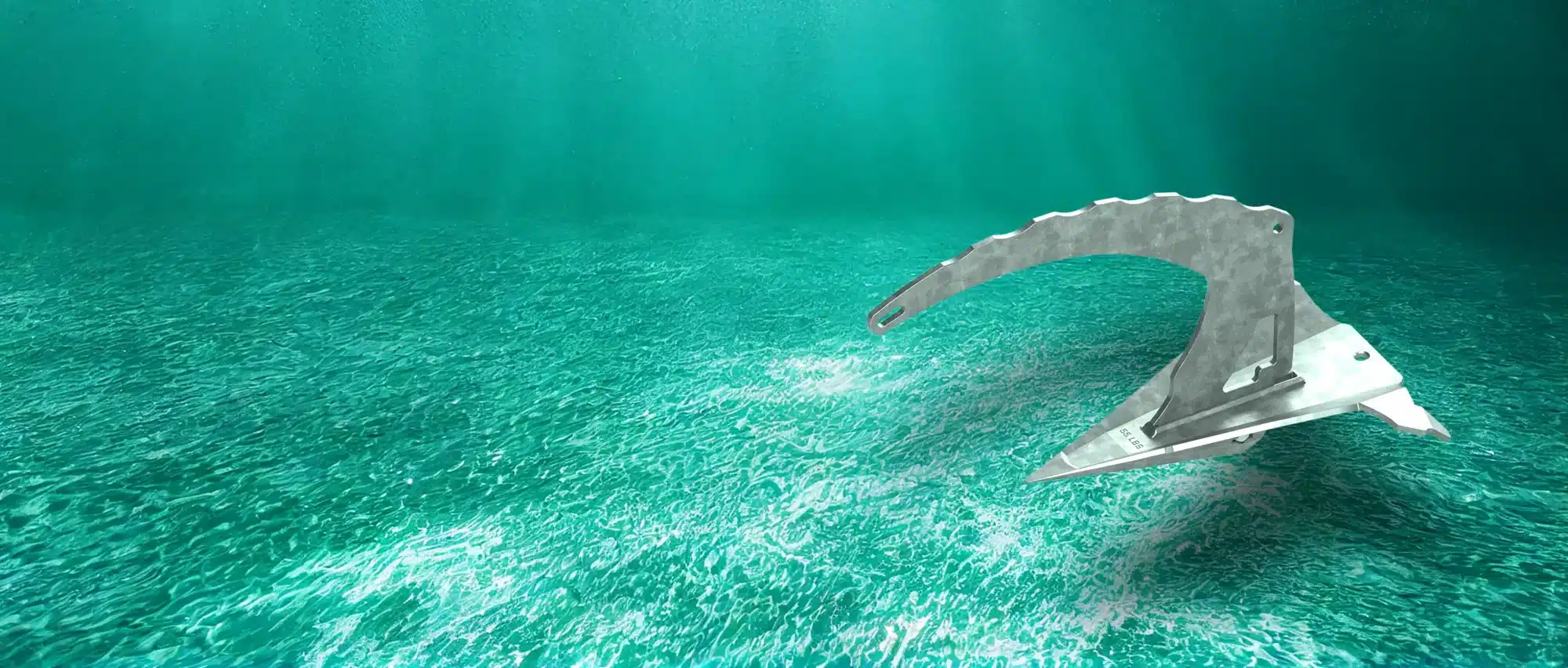
Deploy every anchor you own on the longest scope you can manage. An anchor in a locker holds nothing. If your storm anchor is a size up from your everyday one, this is the day it earns its cost — our M2 Performance is available up to 175 lb, and the galvanized version is the sensible choice for an anchor that will be set hard into mud and possibly left there.
Chafe is what actually sinks boats
This is the part people under-prepare. In hurricane-force conditions a nylon rode working against a chock can part in minutes. It is consistently one of the largest causes of boat loss in storms, and it is almost entirely preventable.
- Protect every point where line touches boat — chocks, the bow roller, pulpit legs, lifeline stanchions, the toe rail, anywhere a line might swing onto under load.
- Use far more chafe gear than feels necessary. Lines move a great deal under storm loading; protection has to cover a much longer span than the contact patch you can see in a calm marina.
- Consider polyester where the line passes through the chock. BoatUS testing found that running polyester from the deck cleat out past the chock resists chafe markedly better than nylon, while still leaving nylon further out in the system to absorb shock. Our 8-plait braided polyester is sold by the foot for exactly this kind of job.
- Rig redundancy. Two independent rodes to two independent strong points, so no single chafe point can release the boat.
Snubbers and bridles: taking the shock out
All-chain rode has almost no stretch. Without a nylon snubber, every gust and every wave arrives at the bow as a shock load — spikes that can reach three times the average load or more. Those spikes are what break gear and drag anchors, and a stretchy nylon snubber converts them into something the boat can absorb.
For storm use, longer is better: more nylon means more stretch and a gentler curve. Rig it so the load is on the snubber and the chain hangs slack behind it, and put chafe protection everywhere it passes the boat.

A bridle spreads the load across two points instead of one, reduces yawing at anchor — which matters because a boat sailing around its anchor generates its own shock loads — and gives you redundancy if one leg fails. Ours use three-strand nylon for stretch, integrated chafe protection, 316L stainless thimbles and forged 2205 duplex shackles. The chain hook that attaches it latches closed around the link, so it cannot fall off during the slack moments between gusts.
Reduce windage and strip the boat
- Remove every sail, including furled headsails. A furled genoa that unrolls in 100 knots will destroy the rig and can drag a boat off its anchor.
- Take off biminis, dodgers, sail covers, awnings and flags.
- Remove the dinghy from davits and stow it below or ashore.
- Lash the boom, remove loose halyards or tie them off away from the mast.
- Clear the decks entirely — anything not bolted down becomes a projectile.
- Seal lockers and hatches, and check that cockpit drains and bilge pumps are clear and working.
- Top up batteries; a bilge pump with no power is decoration.
Gear worth having before the season
| Gear | Why it matters in a storm |
|---|---|
| M2 Performance anchor (to 175 lb) | A storm anchor a size or two above your everyday anchor. Galvanized is the sensible finish for hard sets in mud |
| Mantus Bridle — Universal or Catamaran | Spreads load over two points, cuts yawing, built-in chafe protection, gives redundancy |
| Single leg snubber | Absorbs shock loading on all-chain rode; longer is better for storm use |
| M3 chain hook | Latches closed around the link so it stays attached through slack moments between gusts |
| 8-plait polyester rope | Chafe-resistant where line passes the chock, per BoatUS testing |
| Three-strand nylon rope | Stretch, further out in the system, where shock absorption is wanted |
| Snubber pendant | Two-eye pendant for building a second, independent rode |
| Mooring snap shackle | Secure attachment to a mooring pendant |
Common questions
What scope should I use for a hurricane?
Ten to one is the commonly recommended storm target, against five to one for ordinary conditions — and more if swinging room allows. Critically, calculate it against expected depth including storm surge, not the depth you see today. Scope keeps the pull on the anchor horizontal, and a horizontal pull is what keeps it buried.
Should I haul my boat out or leave it in the water?
Ashore is generally safer and is what most insurers prefer, because it removes storm surge and wave loading entirely. It is not risk-free — boats do blow over in yards, and low-lying yards flood. Check your policy first, since many named-storm clauses require a haul-out by a stated deadline, and book the slot months ahead.
What actually causes most boat losses in a hurricane?
Chafe and storm surge, more than anchors dragging. Lines saw through where they pass the boat, and surge lifts boats over pilings and docks. Both are addressable in advance: over-protect every contact point, and account for surge in how you rig.
How many anchors should I set?
As many as you have. Two is the practical minimum given how far the wind veers as a hurricane passes — either three at roughly 120° apart, or the heaviest into the expected strongest wind with a second roughly opposite. Expect the rodes to end up twisted; that is a problem for afterwards.
Do I need a snubber if I have all-chain rode?
Especially then. Chain does not stretch, so without nylon in the system every gust arrives at the bow as a shock load. Those spikes are what drag anchors and break hardware. For storm use rig the longest snubber you reasonably can, and protect it against chafe along its whole length.
Should I stay aboard to tend the lines?
No. Under no circumstances. Conditions in a hurricane make it impossible to work on deck and impossible to be rescued, and every year people die trying to save a boat that insurance would have replaced. Prepare it, leave it, and go somewhere safe.
Authoritative resources
- NOAA National Hurricane Center — Hurricane Preparedness — forecasts, surge maps and official guidance
- BoatUS Hurricane Resources — claim data on what actually fails, and how
- BoatUS: Chafe Protection in Storms — the testing behind the polyester recommendation
- Ready.gov — Hurricanes — personal and family preparation, which comes first
Keep reading
- Anchor sizing and rode sizing
- Snubbers and bridles — how they work
- Choosing a chain hook
- Galvanized vs. stainless anchors
- Back to the knowledge base
This page is general guidance, not a guarantee. Conditions, boats and anchorages vary enormously, and no preparation makes a boat safe in a hurricane. Follow the instructions of local authorities and your marina, comply with your insurance policy, and never remain aboard.